
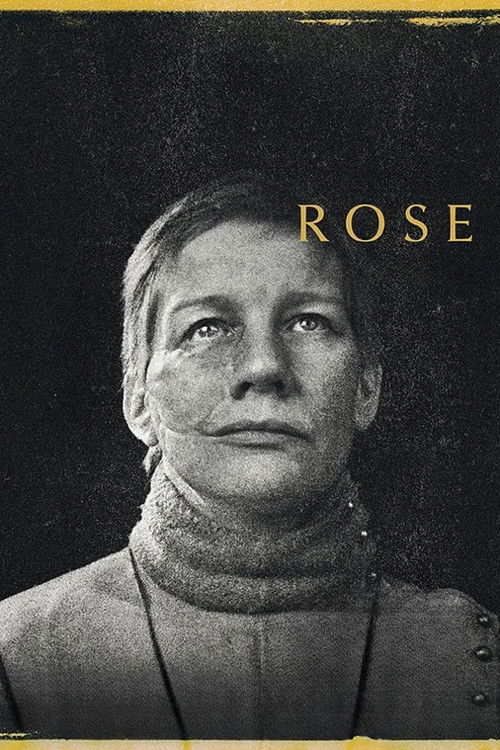
A film by Markus Schleinzer
With: Sandra Hüller, Caro Braun, Marisa Growaldt, Godehard Giese, Robert Gwisdek, Maria Dragus, Annalisa Hohl, Augustino Renken, Maurice Leonard, Emma Bahlmann
In the turmoil of the Thirty-Years’ War, a mysterious soldier appears in a secluded Protestant village claiming to be heir to a long-abandoned manor. His quest for recognition and acceptance are complicated by his secret: under a false identity, false name, and pretense of a false gender, he has made his way to the village. But to achieve her goals, Rose, as the soldier is actually called, will stop at nothing.
Our rate : ★
In recent years, we seem to have encountered many stylistic exercises similar to Rose en festival, which is certainly a sign of a certain modernity—paradoxical for a film that takes us back to the 17th century in a remote region—but we doubt that it can guarantee longevity or artistic genius. Many filmmakers resort to a very heavy-handed, falsely stylized form, seeking to highlight a style that is meant to be provocative, but which is ultimately falsely harsh, falsely austere, and falsely arid. Not everyone can be Haneke; the austerity of an era cannot simply be imposed with force and fanfare, using a few overly common stylistic effects. High-contrast black and white certainly suggests the violence and harshness of the behavior of the era, but it also seems to us to be, above all, a pretext to mask the few seams that Markus Schleinzer felt it necessary to add to his trans character transported to 17th-century Austria, without much finesse. The narration chooses the tone of a fable or even a fairy tale, almost for the sake of convenience, allowing and even justifying artificiality at the expense of what would have been much more interesting to explore on such a subject: authenticity, truthfulness, and the faithful and careful reproduction of an era that would be far removed from any clichés or fantasies.
The omnipresent voiceover, intended to guide the viewer, has the opposite effect: it prevents the director from seeking something else, from escaping into some kind of fantasy, from making detailed observations, or even from offering a detachment that could provide space for reflection. Viewers find themselves somewhat confined, as they are overly guided, trapped by simple facts and a literal narrative that quickly rings false. Strangely, once again, the black and white detracts from the film and, in our opinion, is a bad idea. this story, which objectively speaks not of yesterday but of today, would have benefited from moving forward with more assertive steps and gaining intensity if a colorful atmosphere had been created. Strangely, once again, the message conveyed would have been more intense if it had been embellished with more fantasy and singularity, without didacticism, without pedagogy, without gloves. Strangely, once again, Rose’s seriousness dilutes the power of the message.
The punch that the film seeks to deliver tends to backfire: Rose does not shock, Rose does not surprise. It conveys its message in a very visible, very predictable way, which diminishes our interest. This seriousness also guides Sandra Hueller’s performance, with its exaggerated facial expressions and anger, diminishing the potential for identification that her character normally offers, and the cause she defends. Predictable throughout, the content and form add up, accumulate, and reinforce where the director thinks it necessary to emphasize his message. However, this style, which is assertive, emphatic, and lacking in nuance and complexity, detracts greatly from its persuasiveness. Those who are already convinced will nod in agreement, without feeling enriched or reinforced in their arguments, while those who need convincing are likely to turn away without having deepened their understanding.




Be First to Comment