
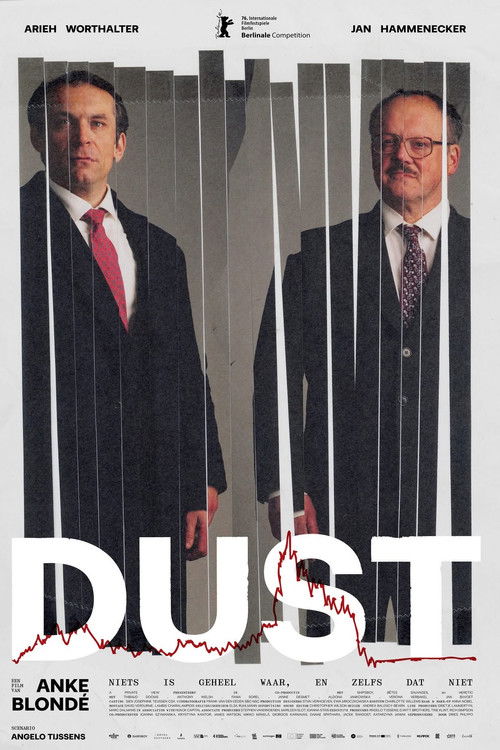
A film by Anke Blondé
With: Jan Hammenecker, Arieh Worthalter, Éric Godon, Dima Savyan, Thibaud Dooms, Janne Desmet, Verona Verbakel, Armin Mola, Fania Sorel, Koen Verledens
When Belgian tech visionaries Luc and Geert learn that their fraud will hit the papers in less than 24 hours, they realise their company and their status will evaporate. With jail time becoming inevitable, they each go on their separate paths of redemption. As they quietly seek atonement from their investors – their families and the close-knit community, they learn what truly matters.
Our rate : ★★
Dust takes us back—which is far from displeasing—to a style of cinema that has fallen out of fashion, almost disappeared from our screens, close to what was one of the hallmarks of American cinema in the 1970s: atmospheric cinema. Anke Blondé fuels what could be described as a thriller with very simple ingredients. She takes a keen interest in her two main characters, in what they feel, what they are experiencing in the present, what goes through their minds in a moment of great stress, when the precipice awaits them. Little by little, their minds become clouded with confusion, they find themselves in a state of great urgency, and their thoughts and actions instinctively turn to a search for what is essential, in the present, but also in relation to what really matters to them. From the very beginning, it is a question of establishing an atmosphere, maintaining it, and at times reinforcing it with small touches, a few subtle details, and other narrative elements that pop up here and there to better understand these very human beings, who are both similar and different, united and attached, but also each with their own rough edges, their daily lives, and their feelings. Through inventive staging and shifting frames, the director manages to bring out the slightest signal perceived by these business leaders on the verge of losing everything, including their dignity, giving the film remarkable coherence and unity. This film deliberately stagnates to make way for renewal and constant twists and turns, aiming to renew the viewer’s interest. Beyond the pure political intrigue, the viewer is offered two fairly intense, highly accurate portraits. This beautiful, masterful exercise in style nevertheless suffers from a pace that, due to the concept being taken to its extreme—this stubborn refusal to leave the characters, to speed up time, to introduce elements of diversion — ends up running out of steam despite the quality of the performances — also very seventies in style — the great care taken with the image and sound, and, as we said, the very existential questions raised by the film.




Be First to Comment