
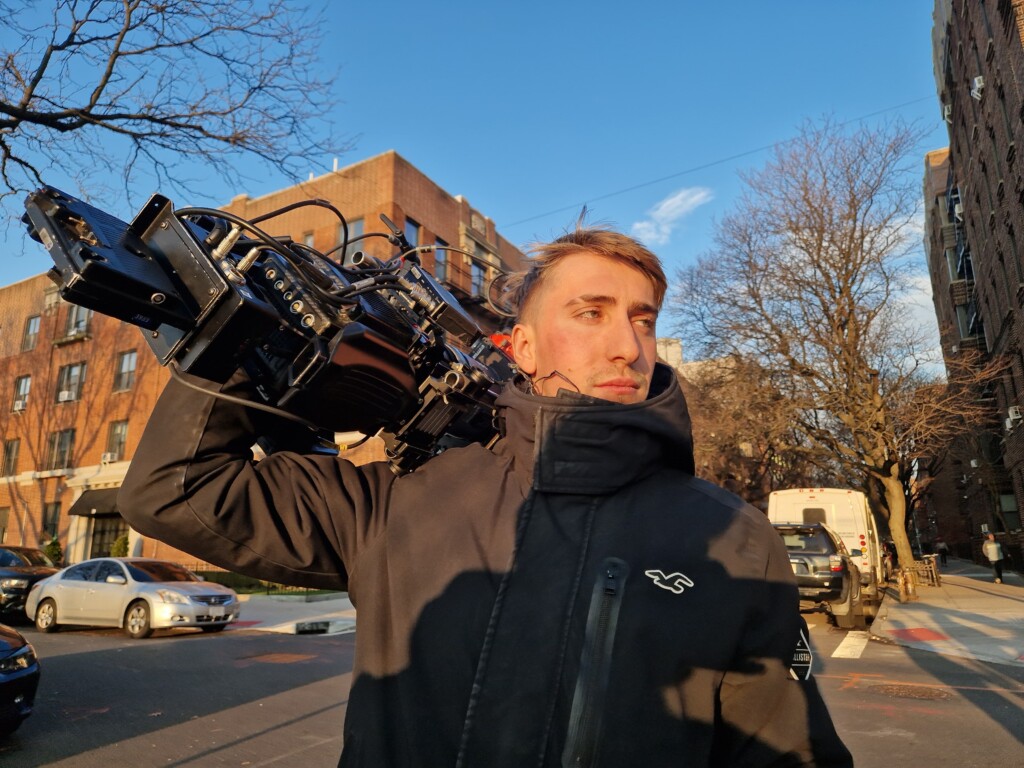
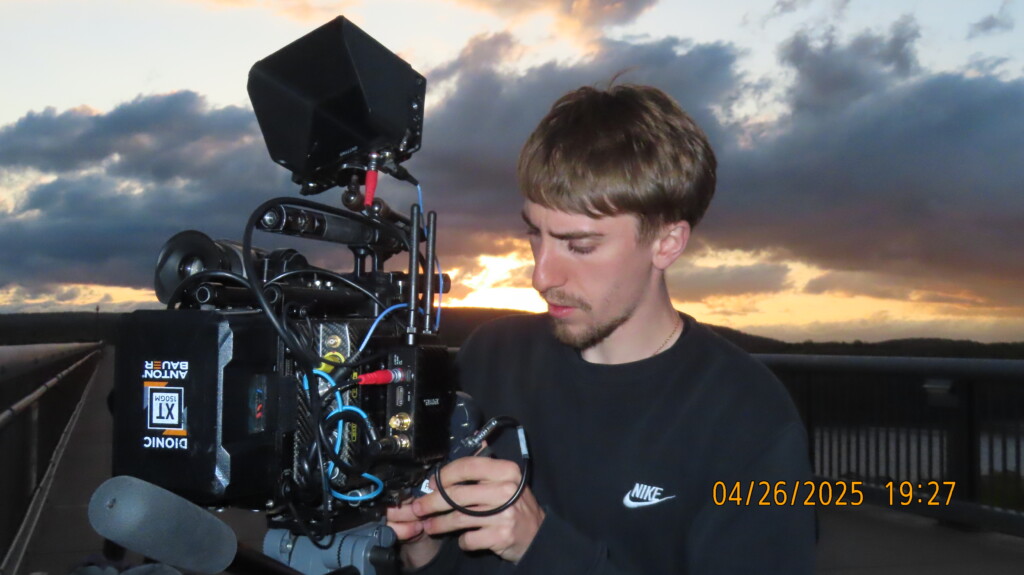
At 23, Hippolyte Charlut embodies a generation of French technicians who refuse to limit their ambitions to France alone. Trained at ESRA, he crossed the Atlantic to immerse himself in the New York ecosystem, going from volunteering on independent sets to working as a paid focus puller. Between linguistic adaptation, a grueling pace, and daily perseverance, his journey questions the persistence of the Hollywood myth: in an American film industry that is more competitive than ever, is the dream still within reach for those who dare to pursue it?
Cinema Reporter (C.R.): Hello Hippolyte, you dream of breaking into American cinema and making a career there. Can you tell us how long you’ve had this dream and what steps you’ve already taken to achieve your ambitions?
Hippolyte Charlut (H.C.): Originally, I had no connection to the world of cinema. I was more of a sports enthusiast, and it was somewhat by chance that I entered the audiovisual world. In high school, I decided to take an audiovisual course for two years to earn some extra points on my high school diploma. It was during this period that I learned the basics, but more importantly, I had the opportunity to test, experiment, and start filming. This discovery quickly turned into a real passion.
After that, I enrolled in film school, where I spent three enriching years. These years allowed me to perfect my technical skills, better understand how film sets work, and confirm my passion for this field. My school also offered a fourth year in New York, an opportunity I seized to explore a new environment, learn in a different way, and have my first international experience.
While there, I had the opportunity to work on several projects that were crucial to my career path. These experiences opened my eyes to my desire to go further, stay longer, and continue learning from the American industry. It was then that my dream of building a career in the United States became a tangible goal. Today, I am pursuing this path with the desire to continue to evolve, discover, and forge a lasting place for myself in American cinema.
L.M.C. Y-a-t-il un film ou une personne en particulier qui a été le point de départ pour toi, et auquel tu reviens souvent ?
H.C. Il est indéniable qu’un projet et plusieurs rencontres ont marqué un tournant décisif dans ma vie. Le film “Manhattan Cowboy, réalisé par Killian Couëffé, a été un moment clé. C’est à travers ce projet que j’ai réalisé que je souhaitais vraiment m’installer aux États-Unis. Le producteur, Arthur Dupuis, avait une solide expérience des tournages américains et de la vie à New York. Il est devenu une véritable référence pour moi ; j’ai pu lui poser toutes mes questions, tant sur le travail que sur la vie quotidienne en tant que Français dans cette ville. Ses retours d’expérience ont été d’une grande valeur.
Le tournage lui-même a été une expérience enrichissante. Les différents lieux de tournage m’ont permis de découvrir des coins de New York que je n’avais jamais explorés auparavant, et j’ai eu la chance de travailler avec un matériel de qualité dans des conditions professionnelles exigeantes. Tout cela a renforcé mon désir de m’ancrer durablement dans cet environnement.
Parallèlement, grâce à mon école, j’ai pu entrer en contact avec des anciens élèves des promotions précédentes, notamment Pierrick Reiss. Il m’a énormément soutenu sur le plan technique, répondant à mes questions sur le métier d’assistant caméra, les attentes sur les plateaux et les moyens de progresser. Il m’a tendu la main à un moment crucial de mon parcours, et je lui en suis profondément reconnaissant.
Enfin, au cours de cette année, j’ai eu l’occasion de rencontrer plusieurs directeurs de la photographie, comme Félix Bailly, Evan Miller et Jeff Malo. Ce sont des professionnels qui continuent de me solliciter pour des projets, de me recommander auprès d’autres équipes et de me prodiguer des conseils. Leur confiance et leur soutien sont essentiels dans mon évolution professionnelle.
C.R.: Why Hollywood, and why American cinema? Is there a period or genre of American cinema that stands out for you more than any other? New Hollywood, perhaps?
H.C. To be honest, my attraction to American cinema did not stem from theoretical reflection or a specific movement at the outset. My first memorable experiences as a viewer were films such as Star Wars and Transformers. These iconic works, deeply rooted in the world of Hollywood, impressed me with their visual scope, technical mastery, and the importance given to the image. Without really realizing it at the time, this is where my interest in image creation took root.
Subsequently, Hollywood and, more broadly, American cinema made a very concrete impression on me, especially when I had the opportunity to visit New York as part of my studies. There, I discovered a very direct and demanding approach to work, where technique serves efficiency and storytelling. This resonates particularly with me as a camera assistant.
Over time, I have also learned to appreciate periods such as New Hollywood, particularly for the creative freedom given to crews and the way in which technique and storytelling evolve together. However, what touches me most today is not a particular genre or era, but rather the energy of American cinema. Its ability to produce quickly and in large quantities, with well-structured teams, while leaving real room for artistic ambition.
It is this balance between technical demands, pace of work, and diversity of projects that made me want to invest myself in this world for the long term.
C.R.: In general, what is your relationship with cinema? Would you say you are passionate about it, and what works and artists sparked your interest?
H.C. My relationship with cinema is undoubtedly a little atypical compared to the traditional image of a “film buff.” For me, it’s the creative process that fascinates me, rather than the final product. I never had that moment of enlightenment where I said to myself, “This is exactly what I want to do” while watching a particular film or artist. What really captivated me was the way a technical team brings a story to life through images.
As a camera assistant, I developed my eye in the field. I learned to appreciate cinema by being on set, realizing how every detail, whether it’s focus, rhythm, anticipating movements, or communicating with the director of photography, can influence the quality of a scene. That’s where my passion really blossomed.
Of course, certain films have had a visual impact on me, particularly big American productions that showcase technique and aesthetics, such as Star Wars and Transformers. However, beyond the works or artists themselves, it was above all the professional encounters that were decisive: the directors of photography and crew leaders I had the opportunity to work with, who instilled in me a sense of rigor, high standards, and a vision of the set.
Today, I would say that my passion for cinema is very concrete: it translates into a concern for a job well done, precision, and the ability to serve a project and a team. It is this approach, deeply rooted in the reality of the set, that best defines me.
C.R.: What do you think of American independent cinema, and how would you compare it to French independent cinema?
H.C. I don’t approach independent cinema from an overly academic theoretical or aesthetic perspective. As a camera assistant, my view is essentially practical and focused on the set. What I observe is that independent cinema, whether American or French, has the ability to produce images that are just as powerful and memorable, even with limited resources.
In my opinion, the real distinction lies more in the way of working. In the United States, even for independent projects, there is often a very structured organization and a very professional set culture, with well-defined roles. In France, on the other hand, independent cinema can sometimes take a more flexible and artisanal approach, which can also lead to a different form of creativity.
When it comes to images, sets and environments play a crucial role. American landscapes, architecture, and atmospheres offer visual settings that are very different from those found in France, thus influencing the final look on screen. However, in both cases, what gives an independent film its strength is above all the intention, the team, and everyone’s commitment to the project.
Ultimately, I wouldn’t say that one is superior to the other. They are two distinct approaches, each with its own constraints and rewards. Working in both environments has above all allowed me to broaden my vision of cinema and of working on set.
C.R.: What do you think of the vitality of American cinema today compared to European cinema? Do you still see connections between them, as there were between New Hollywood and the French New Wave?
H.C. I think that American and European cinema remain very dynamic today, although they are evolving according to different dynamics. The links between the two continue to exist, even if they are no longer as clear as they were in the past, as with New Hollywood or the French New Wave.
At that time, there was a clear desire to break with tradition and take risks in terms of both form and narrative, and these movements communicated intensely with each other. Today, exchanges are more subtle, but just as real. They can be observed through festivals, international co-productions, multicultural teams, and the constant movement of technicians and artists between Europe and the United States.
On set, I notice above all a convergence in working methods and visual references. Many independent American filmmakers continue to draw inspiration from European cinema, appreciating its sense of framing, rhythm, and intimacy. At the same time, European cinema is beginning to incorporate certain American approaches to storytelling, production, and technical efficiency.
So I would say that vitality is very much present on both sides, but it manifests itself in different ways. The major movements may seem less named or theorized, but the cross-influences are constant and very concrete on the ground. Today, this dialogue is built less through manifestos and more through collaboration, individual journeys, and experiences on set.
C.R. In France, there are many voices spreading their disdain for French cinema. We are seeing a real increase in French cinema bashing, sometimes by people who don’t really know much about French cinema, based on prejudice, since they consume American series on streaming platforms in large quantities… What do you think of this black-and-white way of seeing things? Do you agree with it?
H.C. I don’t share this black-and-white view at all. In my opinion, pitting French cinema against American cinema doesn’t really make sense, especially nowadays. These two worlds are very distinct, each with its own production, financing, and distribution logic that are completely different.
I think that some of the criticism of French cinema stems from biased comparisons. Many people consume a multitude of American series, often made with considerable budgets, large teams, and formats adapted to platforms, and then compare them to French films that do not have the same resources, the same ambitions, or sometimes even the same artistic objectives.
French cinema has its limitations, it’s true, but it also has a real strength: freedom of expression, a place for authors, and a diversity of offerings that exist precisely because the system allows for a certain amount of risk-taking. Not everything is always successful, but neither is everything standardized.
As a technician, I see above all the presence of talent, dedicated teams, and a real commitment to hard work on both sides. Quality does not depend on the country, but on the people, the context, and the project. Reducing the debate to statements such as “French cinema is rubbish” or “American cinema is superior” prevents us from understanding what each model has to offer and why they can be complementary rather than opposed.
C.R. What did you think of Sean Baker winning the Palme d’Or for The Big Sick, and what do you think of American films made by French directors, such as Leterrier in the past, or Coralie Forgeat more recently, which are firmly rooted in a particular genre but also make heavy use of special effects?
H.C. The Palme d’Or awarded to Sean Baker seems perfectly in tune with the current evolution of American independent cinema. His work illustrates that it is possible to create deeply human cinema, rooted in reality, without the need for colossal budgets or spectacular special effects. This reminds us that the strength of a film lies in its vision, its characters, and its direction, long before technology.
When it comes to American films made by French filmmakers, such as Louis Leterrier in the past or more recently Coralie Fargeat, it is fascinating to see how they appropriate the codes of genre cinema and the American industry, particularly through a more assertive use of special effects. This contrasts with the traditional image of French cinema, often perceived as having a very limited approach to VFX, almost as a marker of identity.
There is sometimes the idea that the use of special effects could betray a certain purity of cinema, as if a good film must necessarily do without them. Personally, I find this perspective a little reductive. Special effects are above all tools. When used well, they open up immense creative horizons, allow new imaginations to be explored, and offer directors additional freedom.
I think this evolution is beneficial. It does not call into question a film’s ability to be powerful without special effects, but it does demonstrate that there is still so much to invent and experiment with. For French filmmakers, this can be very inspiring: asking themselves, “Now that these tools are at my disposal, what new stories can I tell?” rather than limiting themselves to a pre-established framework.
C.R. Many renowned filmmakers who cross the Atlantic fail to transpose their work, and sometimes make their worst films there (from Kassovitz to Wong Kar Wai), while others are more successful (Almodovar recently). Do you have an explanation for this?
H.C. There is no magic formula to explain why some filmmakers are more successful than others in making the leap to Hollywood. Every film is a risk, and it is impossible to predict its success with certainty, especially in a different cultural and industrial context.
Moving to Hollywood often means facing a wide variety of challenges: a more rigid system, higher financial stakes, greater market expectations, and sometimes reduced artistic freedom. Some directors manage to navigate this new environment, juggling these constraints while preserving their identity, while others may feel out of step with their way of working or storytelling.
Timing and encounters also play a crucial role. A project may fail not because of the filmmaker’s talent, but because it comes at the wrong time, with misguided expectations or without the right people to support it. Conversely, when conditions are favorable, as was recently the case with Almodóvar, the transition can be easier.
Ultimately, every film is a unique adventure. Crossing the Atlantic does not guarantee success or failure: it simply adds another layer of complexity to a profession that, by its very nature, remains unpredictable.
C.R. You now live in the United States. Can you tell us what surprised you most when you arrived, but also what major differences you see today compared to what you experienced in France, whether in everyday life, in teaching, in how cinema is experienced, or in working in the film industry?
H.C. What struck me most when I arrived in the United States, and more specifically in New York, was the omnipresent intensity. Life there is significantly more expensive than in France, whether for housing, food, or transportation, which quickly pushes us to adapt, become more organized, and more self-sufficient. The climate also made an impression on me: it can be very nice for long periods of time, then change radically with snowy winters, scorching summers, and even periods of flooding. You really feel that the city lives to the rhythm of these contrasts.
There are also notable differences in everyday life, particularly when it comes to healthcare. The relationship with doctors, insurance, and medical care is much more complex and stressful than in France, and this is clearly one of the things you have to get used to when you arrive.
When it comes to food, there is a wide variety of choices and cultures, but on a day-to-day basis, the quality is not always as good as in France. Sometimes you have to do some research to eat well, especially when you have a busy schedule.
In terms of education and working in film, the differences are very marked. In the United States, learning is much more interactive: questions are constantly being asked, there is discussion and debate, and students are encouraged to express themselves. In France, the model tends to be more traditional, where students listen more than they question.
During filming, I also noticed a very pragmatic and efficient approach. The teams are fast, well-organized, and there is a real culture of problem solving. Everyone is expected to contribute ideas, while respecting a well-defined hierarchy. This energy, combined with the fast pace of New York, has taught me a lot and continues to help me grow both professionally and personally.
C.R.. Was your acclimatization to the United States a path fraught with obstacles?
H.C. My adaptation to life in the United States has been a real journey fraught with pitfalls. The first challenge was the language: I wasn’t very comfortable with English, and I had to adjust quickly, especially on film sets where the technical vocabulary is almost completely different from what we use in France. Learning the names of all the equipment and tools and understanding the specific terms used on set took a lot of effort on my part.
In everyday life, I also had to learn to express my thoughts clearly, articulate my problems, and deal with administrative procedures, all in a language that was not my own.
There were moments of frustration, with dashed hopes, broken promises, scams, and the departure of some friends to France due to a lack of opportunities. However, all these experiences also made me stronger and more independent, teaching me the perseverance necessary to continue to progress in the industry.
C.R. Does the world of American cinema seem open or closed to you? How does it compare to French cinema? Do you think the American dream is still a reality today?
H.C. I consider the world of American cinema fascinating, with its own unique characteristics. Compared to French cinema, everything seems bigger: the city, the technical resources, the projects underway. Demand is huge, and to be honest, I’ve never been as busy in three weeks in New York as I was in three years in Paris. The days are often very long, sometimes reaching 12 hours, or even 14, 15, or 16 hours.
The “American dream” is still very much alive. Before, I was just getting my foot in the door of the industry; now, I’ve been fully involved for two years, and I don’t yet know what the future holds for me. The possibilities for growth are endless; there is so much to explore and learn. Every day, I meet different people, which constantly opens up new perspectives for me.
C.R. Can you tell us more specifically about your first steps in American cinema, and the initial difficulties you encountered in particular?
H.C. My early days in American cinema were a real challenge. The first difficulty was the language: it wasn’t just a matter of mastering everyday English, but also understanding the technical jargon used on set. Sometimes someone would ask me to “grab the dolly arm,” and I would be perplexed, not immediately knowing what they meant, because it’s not the same term as in French.
Then there’s the fast pace of work. Days can easily reach 12 hours, and sometimes even 14 or 16 hours, not counting travel time, which can take between 30 minutes and 1.5 hours. You also have to adapt to a variety of conditions: shooting in the rain, snow, or sweltering heat, while dealing with technical problems with equipment that can sometimes be faulty.
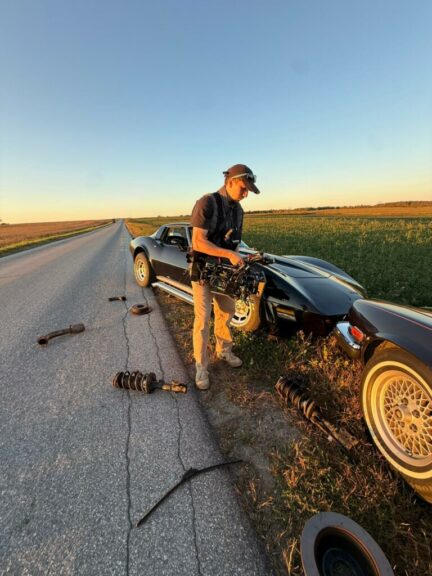
Despite all these challenges, there is immense satisfaction at the end of each project. Seeing my name in the credits of a film shown on the big screen, meeting extraordinary teams, participating in unique projects, discovering fascinating places such as penthouses in Manhattan or sports cars on film sets—all of this reminds me why I am here and why I am passionate about this job. Every day brings new experiences and discoveries, and that’s what drives me forward.
C.R. In France, we have auteur cinema and the cult of the director as artist. In the United States, the approach is very different, and producers have much more control over films. Have you noticed this? And what do you personally think about it?
H.C. As a technician, I have not had the opportunity to be directly involved in production decisions or interactions between directors and producers. Therefore, I cannot really make an in-depth comparison of these different approaches. My experience is mainly focused on technical work on set, and it is in this area that I devote all my energy and passion.
C.R. Shooting schedules in the United States are known to be shorter, and working hours much more flexible on a film set. Would you agree?
H.C. Filming days in the United States are often very long, generally lasting around 12 hours, and can easily extend to 16 hours or more, depending on the project. This fast pace may seem demanding, but it is also what allows you to achieve tangible results and advance quickly in the industry.
C.R. You attended ESRA film school, where you were able to nurture your dream of working in American cinema. Can you tell us about the specific program you enrolled in and how it helped you enter the profession?
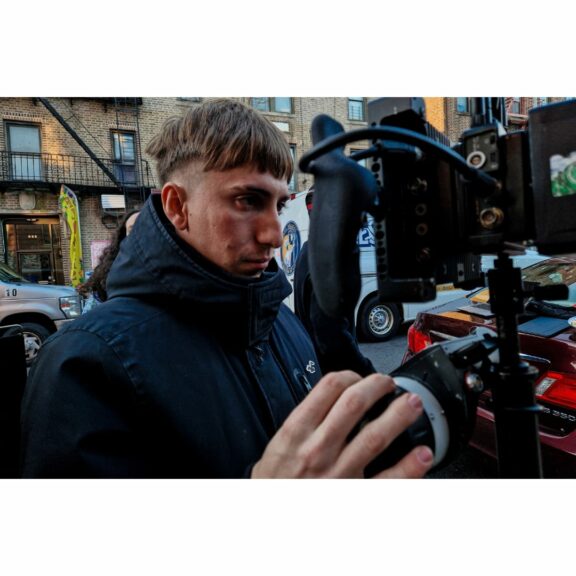
H.C. Above all, ESRA allowed me to lay a solid foundation, both technical and theoretical, to evolve in the world of cinema. The specific program in New York was a real gateway into the American industry: I discovered how film shoots work, learned the technical vocabulary used in the United States, and understood how to communicate effectively on set.
However, beyond the classroom, it’s really in practice that everything comes together: it’s essential to take the plunge, accept that you’ll make mistakes, learn, and persevere. School provides the foundation, but it is each student’s commitment and curiosity that will make all the difference. Another valuable asset is the alumni network: interacting with those who have already proven themselves in the United States provides practical advice and support that school alone could never provide.
C.R. Today, you have several films under your belt. Has it become easier for you to find work? Can you tell us a little about the importance of networking there, and how you made a name for yourself?
H.C. I wouldn’t say that job hunting necessarily becomes easier, but over time, I’ve learned to solve problems much more quickly. I now have a better grasp of the equipment, cameras, lenses, and how a shoot works.
As for networking, it’s absolutely crucial in New York. I started by asking for advice from alumni of my school and all the French people I met in NYC. Then I knocked on the doors of every production company I could find, handing out resumes and explaining that although I couldn’t work legally at the moment, I was willing to offer my help for free. Thanks to this initiative, I was called in on several shoots and was able to collect the contact details of many people to whom I then offered my services.
At the same time, I contacted equipment rental companies to learn the names of the cameras, lenses, and accessories used in the United States. After several months of volunteering, I finally obtained my Social Security number, which allowed me to work legally. Thanks to the many people I met on film sets, I was able to start working, earn a living, and continue to progress in the industry.
C.R. Have there been any decisive encounters yet?
H.C. Yes, I’ve been fortunate enough to have several memorable encounters. Some of my colleagues have become true friends, and I’ve also had the opportunity to meet professionals who are already well established in the industry, such as cinematographers, renowned directors, and technicians who have contributed to iconic films or collaborated with celebrities.
I was even more fascinated by conversations with a technician who, from a purely technical point of view, explained the behind-the-scenes aspects of filmmaking to me, rather than talking to the director himself. It’s a bit like the dream of a little boy who spent hours watching movies on television: to find myself one day on a film set, face to face with those who work behind the camera, is a source of unparalleled excitement and inspiration.
C.R. Have you held various positions that are listed in the credits of films where your name appears (behind the camera or in editing)? Do you have a fixed idea of the job you want to do, or are you more of a jack-of-all-trades who would also like to direct your own films?
H.C. Thanks to the education I received, I had the opportunity to explore all the roles on a film set, which allowed me to acquire fundamental skills in various areas. Before specializing, I took the time to try out several positions in order to better understand each facet of this profession, which helped me make an informed choice. This led me to focus on the role of camera assistant and focus puller, while keeping my curiosity intact and remaining open to other experiences that could enrich my career. Who knows, maybe one day I’ll have the chance to make my own films.
C.R. Generally speaking, you’ve left to settle in the United States. If we meet up again in five years, what would you like to have accomplished by then?
H.C. In five years, I hope to have solidified my presence in the United States by obtaining my visa, which will allow me to pursue my career on various film sets and meet new people in the industry. My wish is to explore a variety of productions—whether series, feature films, commercials, short films, or sporting events—in order to discover the field that fascinates me the most.
Subsequently, I aspire to become a member of the Camera Operators Union, which would give me access to more ambitious projects while ensuring a certain level of professional stability. Finally, I would like to invest in good personal equipment so that I can work independently while maintaining a high level of professionalism.
C.R. Is there a filmmaker or filmmakers you would like to work with more than anything else in the world?
H.C. There are definitely certain directors I would love to work with, especially those who had a profound influence on my childhood and fueled my imagination: Michael Bay, Martin Scorsese, Steven Spielberg, Christopher Nolan… iconic figures in cinema, right? Having the opportunity to work with them would be a dream come true, both in terms of learning and participating in projects that would really challenge me.
As a technician passionate about images, I also dream that some great cinematographers with whom I share a professional connection, such as Roger Deakins, Emmanuel Lubezki, Rodrigo Prieto, Greig Fraser, or even emerging talents like Oren Soffer, known for their unique vision, might one day hear about me, either through their teams or through upcoming projects. It would be simply incredible to be able to work or learn alongside cinematographers of this caliber.
C.R. Actors and actresses too, perhaps?
H.C. When it comes to comedians, I’ve always had a special admiration for those who made an impression on me during my childhood, such as Shia LaBeouf and Megan Fox in Transformers, Hugh Jackman and Jake Gyllenhaal in Prisoners, and Elijah Wood, Ian McKellen, and Viggo Mortensen in The Lord of the Rings. It would be truly incredible to have the opportunity to collaborate or learn alongside them on future projects.
C.R. Do you enjoy working on music videos, short films, medium-length films, and feature films equally?
H.C. Absolutely, each project is a unique adventure for me, and no two experiences are ever the same. I really enjoy working on music videos, short films, medium-length films, and feature films. However, I find that a stronger bond often develops during medium-length and feature film projects. This is because of the time we spend together, which allows us to get to know each other better and share an event or adventure, thereby strengthening the bonds within the entire team.
C.R. Where can our readers discover your work?
H.C. Many of the projects I am working on are still in post-production or being screened at festivals, which means I cannot share them publicly yet. However, I am currently creating a website where you will soon be able to discover all of my work. In the meantime, feel free to take a look at some of my work on Instagram: @hippocharlut, or contact me directly by email at [email protected].




Be First to Comment